
Gongfu Tea: The Art of Brewing Tea

If you’ve begun exploring high-quality loose leaf tea, you may have come across the term Gongfu Tea, also known as Gongfu Cha (潮州工夫茶). It can be understood as a brewing method, a cultural tradition, and a quiet ritual all at once. Sometimes romanised as kung fu, the phrase translates from Mandarin as “making tea with effort.” At its heart, Gongfu Tea is about drawing the fullest expression from tea leaves through care, attention, and experience. Just as kung fu reflects mastery in martial arts, Gongfu practice reflects mastery in tea.
But what does this really mean—and what does it have to do with your teapot? To understand why Gongfu Tea is often referred to as the Chinese tea ceremony, it helps to look at how it differs from Western-style brewing.
In a typical Western approach, black tea is made by adding a spoonful of leaves to a large teapot, covering them with boiling water, and steeping for three to five minutes before pouring into cups. Gongfu Tea takes a different path. The teapot and cups are intentionally small, and a larger amount of tea leaves is infused through a series of short, infusions. Each infusion is poured out completely and enjoyed in sequence, allowing the tea’s aroma, texture, and flavour to evolve with each steep.
The Origin of Gongfu Tea
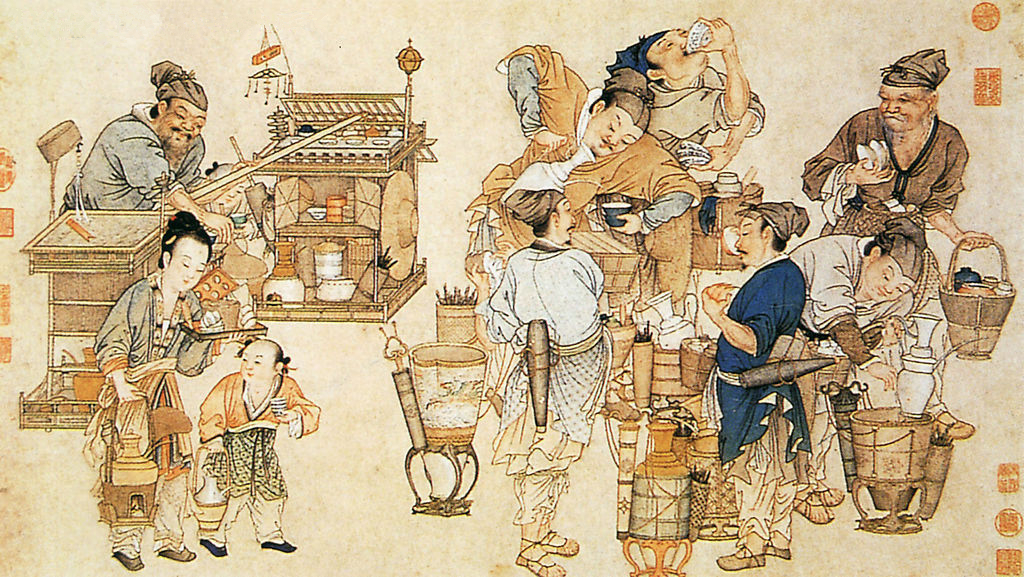 Depiction of a Tea Competition by Zhao Mengfu (1254–1322)
The Gongfu Tea method originated in the Chaozhou region of Guangdong, a mountainous area known for producing Phoenix oolong teas. These teas are prized for their intense fragrance and fruit-forward character, but they can quickly become dark and bitter if steeped for too long. To solve this, local tea drinkers developed a method based on short, repeated infusions, allowing the tea’s best qualities to shine while avoiding harshness.
For much of its early history, Gongfu tea remained a practice reserved for dedicated tea enthusiasts. Its wider adoption came later, as the method spread to the Fujian, where it was applied to celebrated oolongs such as Shui Xian, Da Hong Pao, and Tie Luo Han. From Fujian, Gongfu Tea travelled to Taiwan, carried by migration and a shared oolong tradition. In the 1980s and 1990s, Chinese and Taiwanese collectors began using Gongfu methods to brew Pu Erh tea, though at the time the approach was still relatively unfamiliar to many tea drinkers in Yunnan itself.

It was during the 1980s and ’90s that the once loosely defined practices of “making tea with skill” became formalised into what we now recognise as Gongfu Tea. Gaiwans (盖碗, small, lidded bowl) became widely adopted for brewing many types of tea, evolving from their earlier role as single-person drinking vessels. Sharing pitchers (often called gong dao bei or fairness cups), dedicated tea tables with drainage, bamboo tools, and porcelain cups also became part of the modern Gongfu setup. While oolong and Pu Erh remained central, the method gradually expanded to include white, green, and black teas.
Gongfu brewing is often described in terms of “wet” and “dry” styles. In mainland China, practitioners tend to be generous with water, rinsing teapots and cups until they overflow, with excess water drained through specialised tea tables. In Taiwan, the approach is typically more restrained, with careful water control and tea tables dressed with cloth rather than drainage. In both regions, Gongfu Tea came to symbolise refinement—reflecting not only a drinker’s knowledge, but also the craftsmanship of their teaware.
Today, Gongfu Tea is more popular than ever. That said, it is not the only—or even the most common way tea is brewed in China, where most people still prepare tea in larger pots or mugs, much like in the West. Rather, Gongfu Tea is a powerful tool in a tea maker’s repertoire. When used thoughtfully, it can reveal new layers of aroma, texture, and flavour—even in teas you thought you already knew.
The Gongfu Tea Techniques
Three main factors shape the final brew in Gongfu Tea:
- Amount of tea leaves used
- Temperature of water
- Brewing time
These elements work together to determine the tea’s aroma, body, and flavor across multiple infusions. There is, however, a fourth factor—the tea maker’s style. Tea leaves are alive with dynamic character, and Gongfu Tea is about responding to them with attention and care.
Amount of Tea Used
This is often the first question for beginners. Before deciding how much tea to use, you need to establish two things: the size of your teapot and the type of tea you’re brewing.
The starting point is choosing a teapot that suits the number of people you’ll most often be making tea for. While teapots come in many shapes and styles, their capacities are generally quite standardized. Selecting the right teapot size makes it much easier to determine the correct leaf-to-water ratio.
For a helpful overview of common teapot sizes, shapes, and materials, see: Choosing Teapots – A Quick Guide to Shapes and Materials.

Once you’ve chosen the right teapot, another variable falls into place: how much water to use. Different teas vary greatly in density, which affects how they are extracted. The guide below outlines the most common tea styles. By identifying the tea you’re brewing, you can estimate how much water suit your teapot. These measurements are a starting point—over time, you’ll learn to adjust them to your own taste. For more precise ratios, refer to Artisan Brew on each product’s page.
| Tea Types | Leaf to Water Ratio | Amount of Leaf (per 120ml) | Temperature |
| Green | 1:30 | 4g | 80-85°C |
| White | 1:20 | 5.5g-6.5g | 85-90°C |
| Yellow | 1:20 | 5.5g-6.5g | 85-90°C |
| Black | 1:20 | 6g | 90-95°C |
| Pu Er (raw) | 1:30 | 4g | >95°C |
| Pu Er (ripe) | 1:18 | 6.5g-7g | >95°C |
| Oolong | 1:16 | 7.5g | 90-100°C |
Water Temperatures

Water temperature is one of the most important variables in tea brewing. Making tea is, at its core, the controlled breaking down of the tea leaf’s cell structure to release flavour. Gongfu Cha approaches this process with precision, allowing flavour to unfold fully and consistently across multiple infusions.
If the water is too hot, the leaves break down too quickly; too cool, and extraction is incomplete. In both cases, flavour becomes muted and brews lose balance. Lighter-bodied teas such as green, white, and yellow are best brewed at lower temperatures to avoid over-extraction. Heavier-bodied teas, including black, oolong, and Pu Er, benefit from higher temperatures to draw out depth, structure, and aftertaste.
Water temperature does not need to be exact. A few degrees higher or lower will not ruin a brew. As your skill develops, you’ll naturally learn to adjust steeping time to compensate, refining the balance with each cup.
Brew Times
 Brew Time Progression · 1–50 Seconds
In Gongfu Cha, flavour is shaped not by long extractions, but by short, precise infusions repeated over time.
The guide below offers general guidance for brewing times across most teas. Again, these are starting points, not rules. With practice, you’ll learn to adjust timing instinctively, responding to the leaf, the aroma, and the character of each infusion.
- Rinse: Pour hot water over leaves and immediately discard
- First Infusion: 10-15 seconds
- Second to Third Infusion: 5–15 seconds, adjusting based on taste.
- Subsequent Infusion: Increase time by 10 seconds for each infusion.
Ultimately, brew time depends on the tea itself. Most loose leaf teas can be infused 5–6 times. Some competition grade teas may even last 10–12 infusions. Heavier bodied teas are often steeped for shorter durations, with more infusions, revealing their characters with each brew. In southern Fujian, tea master often combine liquor from several infusions to create a more balanced rounded cup.
A Simple 5 Step Gongfu Tea Guide
Step 1 — Warm the Teapot & Cups
Fill the teapot with boiling water and let it sit briefly to warm the vessel. This helps maintain a stable brewing temperature. Rinse the strainer and teacups with hot water to warm and clean them. Keep your workspace tidy, tools clean, and equipment well-organized for smooth, safe brewing.
Step 2 — Rinse the Leaves
Empty the warming water. Add the measured tea leaves to the teapot. Pour in water at the correct temperature until it slightly overflows. Once bubbles settle and the water runs clear, place the lid on and immediately pour out the water (extend slightly for compressed teas). Tilt the lid open to release excess heat and prevent the leaves from overheating while preserving aroma.
Step 3 — First Brew
For beginners, pour the tea into a small pitcher (fair cup) before serving. This helps keep the brew consistent. Fill the teapot until it overflows, replace the lid, and start timing. For the first few seconds, gently pour hot water over the outside of the teapot to maintain even heat. At the end of the brew time, pour the tea fully into the pitcher. Tilt the teapot lid open. Empty the cups of warming water and serve.
Step 4 — Additional Brews
Repeat Step 3, adjusting brew times as needed, until the tea is exhausted.
Step 5 — Finish
Remove the leaves and leave the teapot open to air dry. Brewing is best done with a dry pot, and this also helps maintain the teapot over time. Rinse all tools and allow them to air dry naturally.
Congratulations — you’re now ready to explore Gongfu Tea.
Experiment with different variables and trust your own taste. Gongfu tea rewards curiosity and practice.